
tabular displays a wide frame; clinical aggregation produces a long Analysis Results Dataset (ARD). pivot_across() is the bridge — it widens an ARD into the frame tabular() consumes.
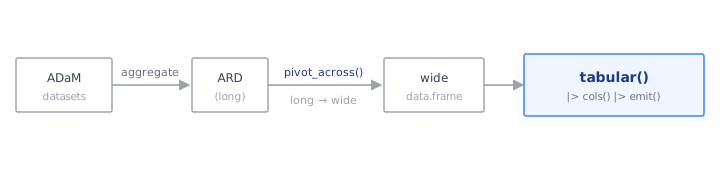
pivot_across() widens it into the wide frame tabular() consumes.The ARDs used below ship with the package, so these examples run without cards/cardx installed; each is shown next to the code that produced it.
The one rule: key statistic by the ARD’s context
pivot_across(statistic = list(...)) matches its list names against the ARD’s context column verbatim. That value depends on which function built the ARD — use the wrong key and those rows are dropped silently. Always check unique(ard$context) first.
| Generating function | context |
|---|---|
cards::ard_summary() |
summary |
cards::ard_tabulate() |
tabulate |
cards::ard_continuous() |
continuous |
cards::ard_categorical() |
categorical |
cards::ard_stack_hierarchical() |
tabulate + hierarchical
|
cardx::ard_categorical_ci() |
proportion_ci |
cardx::ard_continuous_ci() |
continuous_ci |
A single string, or statistic = list(default = ...), applies one format to every context.
Mixed continuous + categorical
cdisc_saf_demo_ard was stacked from a continuous and a categorical block, so it carries the continuous and categorical contexts:
data(cdisc_saf_demo_ard, package = "tabular")
unique(cdisc_saf_demo_ard$context)
#> [1] "continuous"  "categorical" "tabulate"

wide <- pivot_across(
  cdisc_saf_demo_ard,
  statistic = list(
    continuous = c(
      N = "{N}",
      "Mean (SD)" = "{mean} ({sd})",
      Median = "{median}",
      "Min, Max" = "{min}, {max}"
    ),
    categorical = "{n} ({p}%)"
  ),
  # CDISC precision: SD carries one more decimal than the mean. AGE/BMI are
  # whole numbers here (raw precision d = 0), so mean = d + 1 = 1, sd = d + 2 = 2,
  # median = d + 1 = 1, and min/max keep the raw precision (0).
  decimals = c(mean = 1, sd = 2, median = 1, min = 0, max = 0, p = 0)
)
head(wide, 8)
#>   variable stat_label      Placebo Xanomeline High Dose Xanomeline Low Dose
#> 1      AGE          N           86                   72                  96
#> 2      AGE  Mean (SD)  75.2 (8.59)          73.8 (7.94)         76.0 (8.11)
#> 3      AGE     Median         76.0                 75.5                78.0
#> 4      AGE   Min, Max       52, 89               56, 88              51, 88
#> 5   WEIGHT          N           86                   72                  95
#> 6   WEIGHT  Mean (SD) 62.8 (12.77)         69.5 (14.35)        68.0 (14.50)
#> 7   WEIGHT     Median         60.6                 69.0                66.7
#> 8   WEIGHT   Min, Max       34, 86              44, 108             42, 106
#>          Total
#> 1          254
#> 2  75.1 (8.25)
#> 3         77.0
#> 4       51, 89
#> 5          253
#> 6 66.6 (14.13)
#> 7         66.7
#> 8      34, 108
decimals = c(p = 0) gives integer percent with the pharma <1 / >99 thresholds; n = 0 cells collapse to a bare "0" automatically. The widened frame is now ready for tabular() — see Structure.
Confidence-interval cells (and hand-built ARDs)
cardx CI functions emit their own contexts (proportion_ci, continuous_ci) with estimate / conf.low / conf.high stats. pivot_across() consumes any frame that follows the cards long-format, so you can feed it a cardx ARD or build the few rows by hand — useful when a statistic is computed outside cards:
# from cardx:
orr_ard <- cardx::ard_categorical_ci(
  resp,
  by = "TRT01A",
  variables = "RESP",
  method = "clopper-pearson",
  conf.level = 0.95
)
# equivalent hand-built ARD (one row group, proportion_ci context).
# tribble() lays the long ARD out as a literal table: one row per
# (arm, stat), with the estimate and its CI bounds visible inline.
orr_ard <- tibble::tribble(
  ~group1,  ~group1_level,          ~variable, ~variable_level, ~context,        ~stat_name,  ~stat,
  "TRT01A", "Placebo",              "RESP",    "Responders",    "proportion_ci", "estimate",  0.62,
  "TRT01A", "Placebo",              "RESP",    "Responders",    "proportion_ci", "conf.low",  0.50,
  "TRT01A", "Placebo",              "RESP",    "Responders",    "proportion_ci", "conf.high", 0.73,
  "TRT01A", "Xanomeline Low Dose",  "RESP",    "Responders",    "proportion_ci", "estimate",  0.55,
  "TRT01A", "Xanomeline Low Dose",  "RESP",    "Responders",    "proportion_ci", "conf.low",  0.42,
  "TRT01A", "Xanomeline Low Dose",  "RESP",    "Responders",    "proportion_ci", "conf.high", 0.67,
  "TRT01A", "Xanomeline High Dose", "RESP",    "Responders",    "proportion_ci", "estimate",  0.48,
  "TRT01A", "Xanomeline High Dose", "RESP",    "Responders",    "proportion_ci", "conf.low",  0.36,
  "TRT01A", "Xanomeline High Dose", "RESP",    "Responders",    "proportion_ci", "conf.high", 0.60,
)

pivot_across(
  orr_ard,
  statistic = list(proportion_ci = "{estimate} ({conf.low}, {conf.high})"),
  decimals = c(estimate = 3, conf.low = 3, conf.high = 3)
)
#>   variable stat_label              Placebo  Xanomeline Low Dose
#> 1     RESP Responders 0.620 (0.500, 0.730) 0.550 (0.420, 0.670)
#>   Xanomeline High Dose
#> 1 0.480 (0.360, 0.600)
Hierarchical SOC / PT
A hierarchical ARD widens to a soc / label / row_type triple (not a single variable), ready for an indented SOC ▸ PT layout:
data(cdisc_saf_aesocpt_ard, package = "tabular")
ae <- pivot_across(cdisc_saf_aesocpt_ard, statistic = "{n} ({p}%)")
ae$indent_level <- as.integer(ae$row_type == "pt") # depth for col_spec(indent = "indent_level")
head(ae, 6)
#>                                      soc                                  label
#> 1                                Overall                                Overall
#> 2 SKIN AND SUBCUTANEOUS TISSUE DISORDERS SKIN AND SUBCUTANEOUS TISSUE DISORDERS
#> 3 SKIN AND SUBCUTANEOUS TISSUE DISORDERS                               PRURITUS
#> 4 SKIN AND SUBCUTANEOUS TISSUE DISORDERS                               ERYTHEMA
#> 5 SKIN AND SUBCUTANEOUS TISSUE DISORDERS                                   RASH
#> 6 SKIN AND SUBCUTANEOUS TISSUE DISORDERS                          HYPERHIDROSIS
#>   row_type  Placebo Xanomeline High Dose Xanomeline Low Dose indent_level
#> 1  overall 52 (60%)             66 (92%)            81 (84%)            0
#> 2      soc 19 (22%)             35 (49%)            36 (38%)            0
#> 3       pt   8 (9%)             25 (35%)            21 (22%)            1
#> 4       pt   8 (9%)             14 (19%)            14 (15%)            1
#> 5       pt   5 (6%)              8 (11%)            13 (14%)            1
#> 6       pt   2 (2%)              8 (11%)              4 (4%)            1
(Turning soc/label/indent_level into the indented stub is in Structure.)
A two-variable .by
ard_stack(.by = c(ARM, SEX)) carries a second grouping variable. Name it with row_group = and pivot_across() widens it into a leading row column (rather than mis-reading it as a SOC/PT hierarchy). Here is the cards long shape such a stack produces (RACE by ARM within SEX), built by hand so the example runs without cards:
# RACE by ARM within SEX, laid out as a literal tribble: one row per
# (sex, race, arm, stat). Stats are placeholders (n = 10, p = 0.25).
two_by_ard <- tibble::tribble(
  ~group1, ~group1_level, ~group2, ~group2_level, ~variable, ~variable_level, ~context,      ~stat_name, ~stat,
  "ARM",   "Placebo",     "SEX",   "F",           "RACE",    "WHITE",         "categorical", "n",        10,
  "ARM",   "Placebo",     "SEX",   "F",           "RACE",    "WHITE",         "categorical", "p",        0.25,
  "ARM",   "Drug",        "SEX",   "F",           "RACE",    "WHITE",         "categorical", "n",        10,
  "ARM",   "Drug",        "SEX",   "F",           "RACE",    "WHITE",         "categorical", "p",        0.25,
  "ARM",   "Placebo",     "SEX",   "F",           "RACE",    "BLACK",         "categorical", "n",        10,
  "ARM",   "Placebo",     "SEX",   "F",           "RACE",    "BLACK",         "categorical", "p",        0.25,
  "ARM",   "Drug",        "SEX",   "F",           "RACE",    "BLACK",         "categorical", "n",        10,
  "ARM",   "Drug",        "SEX",   "F",           "RACE",    "BLACK",         "categorical", "p",        0.25,
  "ARM",   "Placebo",     "SEX",   "M",           "RACE",    "WHITE",         "categorical", "n",        10,
  "ARM",   "Placebo",     "SEX",   "M",           "RACE",    "WHITE",         "categorical", "p",        0.25,
  "ARM",   "Drug",        "SEX",   "M",           "RACE",    "WHITE",         "categorical", "n",        10,
  "ARM",   "Drug",        "SEX",   "M",           "RACE",    "WHITE",         "categorical", "p",        0.25,
  "ARM",   "Placebo",     "SEX",   "M",           "RACE",    "BLACK",         "categorical", "n",        10,
  "ARM",   "Placebo",     "SEX",   "M",           "RACE",    "BLACK",         "categorical", "p",        0.25,
  "ARM",   "Drug",        "SEX",   "M",           "RACE",    "BLACK",         "categorical", "n",        10,
  "ARM",   "Drug",        "SEX",   "M",           "RACE",    "BLACK",         "categorical", "p",        0.25,
)

pivot_across(
  two_by_ard,
  column = "ARM",
  row_group = "SEX",
  statistic = list(categorical = "{n} ({p}%)")
)
#>   SEX variable stat_label  Placebo     Drug
#> 1   F     RACE      WHITE 10 (25%) 10 (25%)
#> 2   F     RACE      BLACK 10 (25%) 10 (25%)
#> 3   M     RACE      WHITE 10 (25%) 10 (25%)
#> 4   M     RACE      BLACK 10 (25%) 10 (25%)
When a 2-variable .by is present you must say which variable is the arm column (column =) and which is the row dimension (row_group =); the SEX column then composes with subgroup() or group_rows() downstream. cards encodes a crossing factor and a real hierarchy identically, so the declaration is what disambiguates them — leave row_group unset for a genuine SOC/PT hierarchy.
Variables as column bands
Two analysis variables side by side — AVAL (“Value”) and PCHG (“Percent Change from Baseline”) — is the canonical “value and change” shell. Make the variable a column band with the reserved .variable token in column. Each band keys its own statistic / decimals, so the bands may carry different (even different-length) stat lists; ragged bands pad with NA.
# AVAL + PCHG by AVISIT x TRTA, built by hand so the example runs without cards.
valchg_ard <- tibble::tribble(
  ~group1,  ~group1_level, ~group2, ~group2_level, ~variable, ~context,      ~stat_name, ~stat,
  "AVISIT", "DAY 1",       "TRTA",  "Drug",        "AVAL",    "continuous",  "N",        20,
  "AVISIT", "DAY 1",       "TRTA",  "Drug",        "AVAL",    "continuous",  "mean",     324,
  "AVISIT", "DAY 1",       "TRTA",  "Drug",        "AVAL",    "continuous",  "sd",       106,
  "AVISIT", "DAY 1",       "TRTA",  "Drug",        "AVAL",    "continuous",  "median",   315,
  "AVISIT", "DAY 1",       "TRTA",  "Placebo",     "AVAL",    "continuous",  "N",        20,
  "AVISIT", "DAY 1",       "TRTA",  "Placebo",     "AVAL",    "continuous",  "mean",     318,
  "AVISIT", "DAY 1",       "TRTA",  "Placebo",     "AVAL",    "continuous",  "sd",       98,
  "AVISIT", "DAY 1",       "TRTA",  "Placebo",     "AVAL",    "continuous",  "median",   310,
  "AVISIT", "DAY 1",       "TRTA",  "Drug",        "PCHG",    "continuous",  "N",        20,
  "AVISIT", "DAY 1",       "TRTA",  "Drug",        "PCHG",    "continuous",  "mean",     -16,
  "AVISIT", "DAY 1",       "TRTA",  "Drug",        "PCHG",    "continuous",  "sd",       5,
  "AVISIT", "DAY 1",       "TRTA",  "Placebo",     "PCHG",    "continuous",  "N",        20,
  "AVISIT", "DAY 1",       "TRTA",  "Placebo",     "PCHG",    "continuous",  "mean",     -14,
  "AVISIT", "DAY 1",       "TRTA",  "Placebo",     "PCHG",    "continuous",  "sd",       5,
)
Stats as rows — column = c(".variable", "<arm>"). Each variable becomes a band of arm columns; the statistics stack as rows and cells are combined strings. The emitted columns are named "<variable>..<arm>":
pivot_across(
  valchg_ard,
  column = c(".variable", "TRTA"),
  row_group = "AVISIT",
  statistic = list(
    AVAL = c(N = "{N}", "Mean (SD)" = "{mean} ({sd})", Median = "{median}"),
    PCHG = c(N = "{N}", "Mean (SD)" = "{mean} ({sd})")
  ),
  decimals = list(AVAL = c(mean = 1, sd = 2, median = 1), PCHG = c(mean = 1, sd = 2))
)
#>   AVISIT stat_label     AVAL..Drug AVAL..Placebo   PCHG..Drug PCHG..Placebo
#> 1  DAY 1          N             20            20           20            20
#> 2  DAY 1  Mean (SD) 324.0 (106.00) 318.0 (98.00) -16.0 (5.00)  -14.0 (5.00)
#> 3  DAY 1     Median          315.0         310.0         <NA>          <NA>
Stats as columns — column = c(".variable", ".stat"). Each statistic entry becomes its own column (the landscape shell) and the arm drops to a leading row stub. The emitted columns are named "<variable>..<stat-entry>":
pivot_across(
  valchg_ard,
  column = c(".variable", ".stat"),
  row_group = "AVISIT",
  statistic = list(
    AVAL = c(N = "{N}", Mean = "{mean}", SD = "{sd}"),
    PCHG = c(N = "{N}", Mean = "{mean}")
  ),
  decimals = c(mean = 1, sd = 2)
)
#>   AVISIT    TRTA AVAL..N AVAL..Mean AVAL..SD PCHG..N PCHG..Mean
#> 1  DAY 1    Drug      20      324.0   106.00      20      -16.0
#> 2  DAY 1 Placebo      20      318.0    98.00      20      -14.0
You reference the emitted "<variable>..<arm>" / "<variable>..<stat>" names verbatim in a manual headers() call to draw the band spanners — pivot_across() never builds spanners itself.
Auxiliary comparison columns
A between-arm comparison (difference, hazard ratio, p-value) is not a pivot of the main ARD’s rows — it is a separate ARD (e.g. from cardx). Bind it with aux =, aligned 1:1 on the row_group key; the entry name becomes the column.
resp_main <- tibble::tribble(
  ~group1,  ~group1_level, ~group2, ~group2_level, ~variable, ~context,     ~stat_name, ~stat,
  "PARAM",  "ORR",         "TRTA",  "Exp",         "AVAL",    "continuous", "mean",     2.2,
  "PARAM",  "ORR",         "TRTA",  "Ctl",         "AVAL",    "continuous", "mean",     1.9,
  "PARAM",  "DCR",         "TRTA",  "Exp",         "AVAL",    "continuous", "mean",     2.4,
  "PARAM",  "DCR",         "TRTA",  "Ctl",         "AVAL",    "continuous", "mean",     2.0,
)
diff_ard <- tibble::tribble(
  ~group1, ~group1_level, ~variable, ~context,     ~stat_name, ~stat,
  "PARAM", "ORR",         "d",       "continuous", "mean",     0.12,
  "PARAM", "DCR",         "d",       "continuous", "mean",     0.20,
)

pivot_across(
  resp_main,
  column = "TRTA",
  row_group = "PARAM",
  statistic = list(continuous = "{mean}"),
  aux = list(
    "Difference" = list(ard = diff_ard, statistic = "{mean}", decimals = c(mean = 2))
  )
)
#>   PARAM variable stat_label Exp Ctl Difference
#> 1   ORR     AVAL       AVAL 2.2 1.9       0.12
#> 2   DCR     AVAL       AVAL 2.4 2.0       0.20
One aux entry is one column; add more entries (estimate then p-value) for several comparison columns. The auxiliary ARD must reduce to one row per row_group key — a many-to-many alignment aborts rather than fabricate rows.
Key statistic by the context
The one thing to get right: key statistic by the ARD’s context. Inspect unique(ard$context) and key the list to match (or pass a single string / default =). If an explicitly-supplied statistic matches no context, pivot_across() warns rather than silently falling back to {n}.